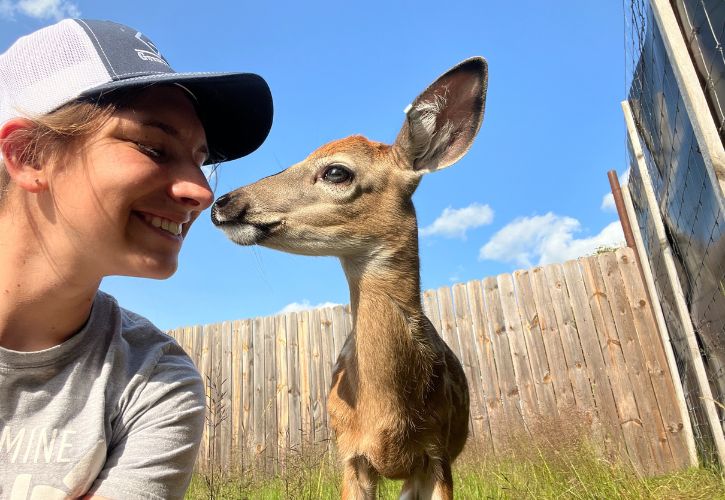
Every student studying Environmental Science and Environmental Justice and Sustainability at Bellarmine is required as a part of their degree program to complete an internship
for credit. These internships can vary quite a bit in the environmental field, from
working in a corporate sustainability office, monitoring and testing waterways, working
in a national park, or in the case of Leia Staples, senior Environmental Science major,
learning what it takes to work in the field of wildlife conservation and protection. By Leia Staples In the summer of 2023, I was accepted to participate in an internship
at Gutierrez Cervid Company (GCC) at Legends Ranch in Bitely, Michigan. This unique
experience was my dream internship. Every day I was able to observe animal behavior
in white-tailed deer. While the deer are kept in captivity, they still have natural
instincts and are considered wild animals. Every day, I inspected every buck, doe
and fawn for signs of injury or illness.
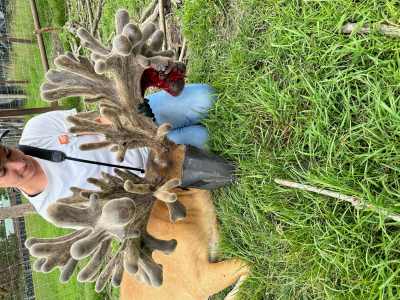
Bucks commonly have antler injuries and may need to be tranquilized to clean an injury
or to cut their antlers off. If left unattended, these injuries can cause death through
blood loss or maggots. A bloody antler attracts flies/fly eggs, and maggots cause
infection and death. After their antlers are cut, bucks are given infection drugs
and dewormed. I learned to place bands to cut off blood flow and feeling, cut off
the antlers, cauterize them to stop bleeding, and spray with treatments to prevent
infection or short-term bleeding. For all deer, common illnesses include abscesses,
which require an incision and draining plus infection drugs. Pneumonia requires infection
drugs and fluids. Hoof rot, which is evidenced by a limp and/or swelling of the hooves,
is treated with infection drugs and dousing the hooves with hoof rot spray. Lumpy
jaw, an infection and swelling in the jaw, also requires infection drugs. Infection
drugs are administered with four injections, including a pain reliever, vitamins and
medication to kill infection. Additionally, I tagged fawns. Tagging allows for the
tracking of detailed records of each fawn’s medical history, which involves administering
preventative medication for E. coli and spraying iodine to prevent common infections
in the hooves and umbilical cord. If a fawn gets E. coli, treatment includes two oral
drugs and three injections each day symptoms are present, up to four days. Afterward,
two oral medications are given to treat symptoms. At this point, the fawn will either
fight off the disease or succumb to it.
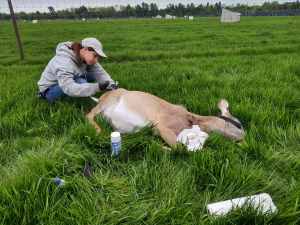
I learned how to give injections, restrain a fawn, tranquilize, and treat all the
illnesses described above. I learned how to recognize signs of illness. I also learned
how to dart deer using certain medications that do not require full tranquilization.
This is less stressful for the deer and still provides relief. I noticed E. coli
in one fawn, caught her and gave her the first day of treatment. A couple of weeks
later, she had lumpy jaw, which I also treated. Both of these conditions can cause
death in a fawn, and I saved her twice. This experience was truly amazing and unforgettable.
I was able to practice animal observation and gain experience with animal treatment.
While not every fawn could be saved, I know I played a vital role in ensuring the
survival of some of them.