The Appalachian region has had a historically strong reliance on the coal industry. Coal provided them with electricity and well-paying jobs to support their families. This dependence is even stronger considering the lack of other opportunities in the region. Coal mining, however, causes a large amount of ecological and health damage. The people in these regions face the damaging health effects of the coal industry and see environmental degradation in their own backyards. The type of mining that occurs in the Appalachian region is a type of surface mining called mountaintop removal. This mining is done by blasting the rock material, soil and other overburden off the top of the mountain. This process forever changes the contour of the mountain along with the ecosystem it once provided.
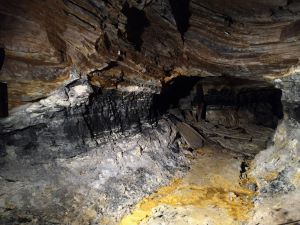 Our first stop on the trip was the Barthell Coal Camp. This site is a preserved coal
mining town that once supplied everything the coal miners needed, including a barber
shop, grocery store and a doctor's office. At the site,
we went inside one of the previous mines. The coal miners there worked 12-hour days,
six days a week. In some areas, the shaft was only 3 feet tall, leaving miners to
have to work on their hands and knees. In addition, rock falls were so common they
had a nurse on site for injuries. At the Barthell Coal Camp, the effects of acid mine
drainage were also visible. This occurs when heavy metals, minerals and water from
coal mines react with oxygen to form highly acidic water. Next, we visited the Blue
Heron Site. Blue Heron is an abandoned coal mining town on the banks of the Big South
Fork River. It was owned by the Sterns Coal and Lumber Company and operated from 1937-62.
While at the site we had the privilege of speaking
with members of the Kentucky Division of Abandoned Mine Lands, Lucas Graham ’14, Tim
Rader and Robert Cammack. The Division of Abandoned Mine Lands is a state agency charged
with reclaiming mine sites abandoned by coal companies and restoring
them ecologically. We also got to stop at Cumberland Falls State Park for a short
time to explore the park on our own. My friend and I saw a garter snake! Our last
stop of the day was the Pine Mountain Settlement School, where we stayed the night.
The school was founded as a school for rural children in the region. Today it focuses
on Appalachian education including environmental education, agriculture
and Appalachian culture. At the settlement school, we took a night hike through the
Appalachian forest. We saw much of the native biodiversity that the region possesses
including newts, salamanders, frogs and lots of beautiful native flora.
Our first stop on the trip was the Barthell Coal Camp. This site is a preserved coal
mining town that once supplied everything the coal miners needed, including a barber
shop, grocery store and a doctor's office. At the site,
we went inside one of the previous mines. The coal miners there worked 12-hour days,
six days a week. In some areas, the shaft was only 3 feet tall, leaving miners to
have to work on their hands and knees. In addition, rock falls were so common they
had a nurse on site for injuries. At the Barthell Coal Camp, the effects of acid mine
drainage were also visible. This occurs when heavy metals, minerals and water from
coal mines react with oxygen to form highly acidic water. Next, we visited the Blue
Heron Site. Blue Heron is an abandoned coal mining town on the banks of the Big South
Fork River. It was owned by the Sterns Coal and Lumber Company and operated from 1937-62.
While at the site we had the privilege of speaking
with members of the Kentucky Division of Abandoned Mine Lands, Lucas Graham ’14, Tim
Rader and Robert Cammack. The Division of Abandoned Mine Lands is a state agency charged
with reclaiming mine sites abandoned by coal companies and restoring
them ecologically. We also got to stop at Cumberland Falls State Park for a short
time to explore the park on our own. My friend and I saw a garter snake! Our last
stop of the day was the Pine Mountain Settlement School, where we stayed the night.
The school was founded as a school for rural children in the region. Today it focuses
on Appalachian education including environmental education, agriculture
and Appalachian culture. At the settlement school, we took a night hike through the
Appalachian forest. We saw much of the native biodiversity that the region possesses
including newts, salamanders, frogs and lots of beautiful native flora. 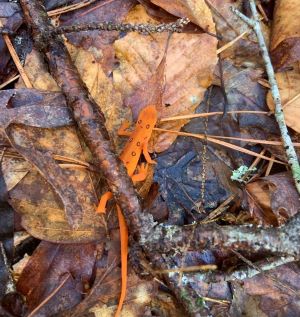 The next day, we continued our journey around Eastern Kentucky. Our next stop was
Blanton Forest on Pine Mountain in Harlan County. Blanton Forest is the largest old-growth
forest in Kentucky—meaning the forest has been unexploited and virtually
undisturbed from its natural state. We hiked to the top of Knobby Hill. Along the
way, we saw snails, a green salamander, a red salamander, a spring salamander and
many newts. My favorite part was the immense amount of moss and lichen, which is
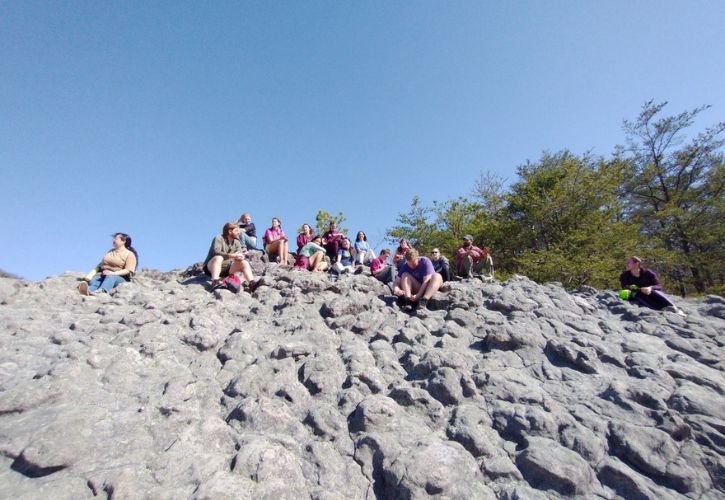
an indicator of good air quality. All the Environmental students, Professor Randy
Strobo, and our tour guide, Derrick Lindsay on the top of Knobby Hill. Photo by Dr.
Kate Bulinski Our last stop was a visit to the Appalachian Citizens Law Center to
speak to environmental attorney Mary Cromer. The Appalachian Citizens Law Center is
a non-profit law firm that fights for justice for coal miners and those affected by
the coal industry.
Mary Cromer specializes in environmental justice cases relating to the coal mining
industry, which in recent years included fighting for coal miners’ benefits after
they are diagnosed with black lung disease, an illness caused by inhaling dust
in the mines. The center’s office was affected by the disastrous floods that occurred
in Eastern Kentucky in the summer of 2022. Mary Cromer talked about how mountaintop-removal
coal mining increased flooding in the region because it disrupts the headwaters that
flow on the tops of mountains and leaves barren stone. Mountain tops, full of trees
and soil, have a higher capacity to hold water, rather than the barren rock left over
from mountaintop-removal coal mining. I can confidently say this trip has been one
of my most memorable and exciting experiences at Bellarmine. Through this immersive
experience in Eastern Kentucky, we were able to learn about the Appalachian environment,
history, culture and its legacy today. Sophy Fields is a senior Environmental Justice and Sustainability major.
The next day, we continued our journey around Eastern Kentucky. Our next stop was
Blanton Forest on Pine Mountain in Harlan County. Blanton Forest is the largest old-growth
forest in Kentucky—meaning the forest has been unexploited and virtually
undisturbed from its natural state. We hiked to the top of Knobby Hill. Along the
way, we saw snails, a green salamander, a red salamander, a spring salamander and
many newts. My favorite part was the immense amount of moss and lichen, which is
an indicator of good air quality. All the Environmental students, Professor Randy
Strobo, and our tour guide, Derrick Lindsay on the top of Knobby Hill. Photo by Dr.
Kate Bulinski Our last stop was a visit to the Appalachian Citizens Law Center to
speak to environmental attorney Mary Cromer. The Appalachian Citizens Law Center is
a non-profit law firm that fights for justice for coal miners and those affected by
the coal industry.
Mary Cromer specializes in environmental justice cases relating to the coal mining
industry, which in recent years included fighting for coal miners’ benefits after
they are diagnosed with black lung disease, an illness caused by inhaling dust
in the mines. The center’s office was affected by the disastrous floods that occurred
in Eastern Kentucky in the summer of 2022. Mary Cromer talked about how mountaintop-removal
coal mining increased flooding in the region because it disrupts the headwaters that
flow on the tops of mountains and leaves barren stone. Mountain tops, full of trees
and soil, have a higher capacity to hold water, rather than the barren rock left over
from mountaintop-removal coal mining. I can confidently say this trip has been one
of my most memorable and exciting experiences at Bellarmine. Through this immersive
experience in Eastern Kentucky, we were able to learn about the Appalachian environment,
history, culture and its legacy today. Sophy Fields is a senior Environmental Justice and Sustainability major.