With a full semester of pandemic-influenced academic instruction on the books, Bellarmine
is making a significant investment in technology to further enhance online teaching
and learning in Spring 2021—and beyond. The university developed a mix of class types
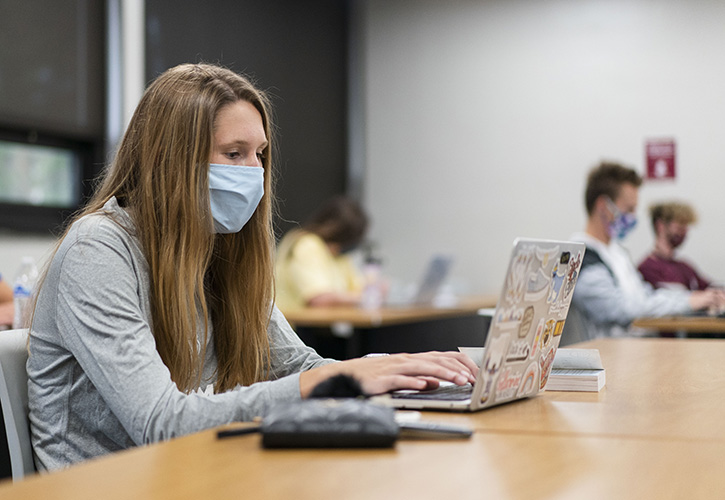
in Fall 2020 to provide optimal learning in a safe environment. Seventeen percent
of the courses available were taught completely in person, with masked participants
physically distanced from each other;
33 percent were completely online; and 36 percent were HyFlex, short for Hybrid-Flexible,
where some students are present in the classroom while others are attending online.
(The remaining 14 percent were individualized offerings, such as clinicals.)
Students and faculty were surveyed about their classroom experiences at several points
during the semester. “One of the biggest challenges we learned about from our data
collection related to weaknesses in HyFlex classes,” said Dr. Paul Gore, vice president
for Academic Affairs and provost.
Faculty had difficulty seeing their online students while teaching with a single
small monitor. Online students had issues seeing and hearing the instructor and viewing
some teaching materials, such as the whiteboards in the physical classrooms. And
students both on-site and online couldn’t always see and hear each other. “Our HyFlex
approach was a success in the vast majority of classes, thanks to the diligence and
relentless commitment of our faculty,” said Adam Elias, director of Innovative Learning
Systems. “Bellarmine’s foray into HyFlex
wasn’t perfect by any means, but the fall allowed us to identify gaps in the equation,
and to make plans for addressing those in the spring.” The improvements include:
- Upgrading every classroom on campus with an industry-leading Logitech webcam, which
will provide better image quality and microphone performance.
- Outfitting 20 high-use classrooms with 65-inch LED monitors on a mobile cart that
will allow the instructor and students in the classroom to see all online students
on one large screen during class.
- Providing faculty access to a variety of additional technologies to improve both audio
and image quality in HyFlex and online classes, including drawing tablets and document
cameras for digital whiteboard alternatives; conference microphones;
wearable amplifiers; and soundbar speakers for enhanced sound.
In addition, Microsoft Teams, the platform that Bellarmine uses for online learning,
is expected to release a long-anticipated upgrade to breakout rooms, which will improve
small-group discussion and projects. Beyond Spring 2021, the upgrades will increase
Bellarmine’s capacity for online course offerings in the future. “We approached this
new equipment with a post-COVID world in mind,” Elias said. “It’s all portable
and easily reallocated to other classrooms or purposes, either for continued hybrid/online/HyFlex
delivery, or other university purposes.” In early December, the Faculty Development
Center held a three-day Reboot Camp, with two days devoted to HyFlex teaching and
the third to faculty show-and-tell sessions about methods and tools they had found
to be successful. “I was excited to hear during the Reboot Camp that Bellarmine
is investing in more technology to continue to improve the HyFlex experience,” said
Jennifer Miller, assistant professor of Nursing, who taught several HyFlex courses
in Fall 2020.
“Better webcams and additional, big-screen monitors in the classroom will help faculty
engage with students who choose to or need to attend virtually. I’m excited to build
on what I’ve learned about student engagement and
to use these technology improvements to capture that community feeling we all enjoy
in our small classes at Bellarmine.” Nicole Cooney, a first-year student from Knoxville,
Tennessee, said she appreciated her professors’ patience in helping her adjust to
new technology. “It gets draining at points, but the professors really try and push
you to get
there and meet your goal during this hard time.” Dr. Roberta Challener, an associate
professor in the Department of Biology, said Elias and Janice Poston, an instructional
developer in the Faculty Development Center, have provided great support with technology
in the classroom or lab. She
also enjoyed the Reboot Camp. “It has been really great to hear from my colleagues
and see how everyone is rising to the challenges we have been presented with,” she
said. “Not only does it encourage me to ‘get back in there’ and keep trying,
but it also reminds me of how lucky I am to be surrounded with such intelligent, talented
and caring people. I haven’t used the new webcams yet, but if they allow me to control
the focus and don’t make clicking noises, then
I’ll be quite excited to offer an improved online experience for our students.” She
also looks forward to using a new camera that will allow her to share microscope slides
in real time. “I actually think it might end up being a more inclusive learning experience
than if students were looking through their own microscopes,
because all the students will be able to see and learn what they are supposed to see,”
she said. “Some students are too shy to ask for help or don’t know that they are looking
at the wrong things.” While students and faculty—along with the rest of the world—are
suffering from technology fatigue right now, Elias said he is confident that online
and HyFlex instruction will be even better after the holiday break. “Thanks to their
resilience and the new investment in classroom upgrades, you can bet that Bellarmine’s
faculty will be ready for Round 2 in the spring!”