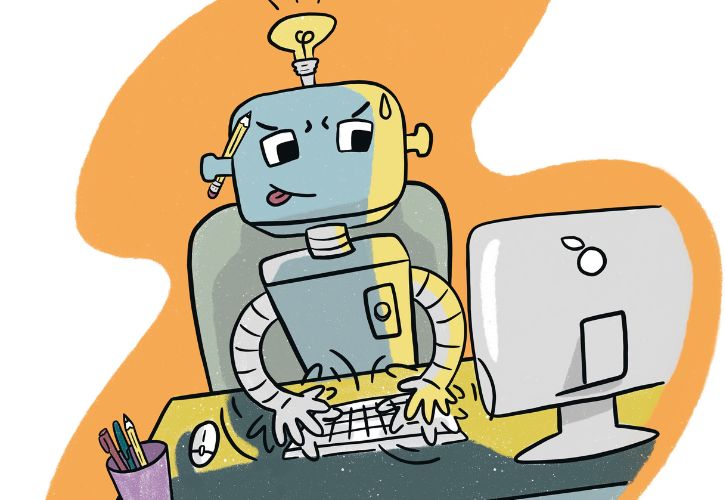
The recent explosion of interest in and use of generative artificial intelligence
extends well beyond the realm of traditional information technology industries. AI
is the topic of conversation at water coolers, strategy meetings and board rooms everywhere.
As Bellarmine University prepares students to be successful leaders in their fields,
here are five careers poised to see immense change wrought by AI.
Read more about generative AI and its implications.
Healthcare
If the pandemic’s aftermath saw the remote doctor visit as a new normal, expect AI
to raise the bar on what’s possible—responsibly—in connecting people with individualized
care. Could this mean an AI-driven chatbot “sees” patients, perhaps supervised by
a licensed practitioner? Perhaps more likely initially, health-focused information
repositories online may be enhanced to boost interactivity and the ease with which
specific and finely tuned answers are found by the ailing. Think WebMD on steroids.
If nothing else, nurses, therapists, physicians and other healthcare professionals
will find new AI-enabled tools and technologies available to them as they seek to
provide effective and patient-centered care, which is exactly what Bellarmine seeks
to promote.
Medical science and research
Artificial intelligence stands to substantially increase the power of research in
the medical field. We’re already seeing cases where the ability of AI to analyze data
and identify even the most obscure patterns in patient imaging has led to unprecedented
advances in the early detection of tumors and cancer cells. AI is literally saving
lives already. As AI tools proliferate in medical science, will we begin to see disease
increasingly discovered in otherwise healthy people, with late-stage surprises diminishing?
Could AI-driven medical research bring a whole new level of strength to the war against
cancer?
Education
ChatGPT has collectively awed the world over the past few months because of its ability
to mimic a human—a very capable one. In education, the concept of individual tutoring
has long been deemed to be among the most effective forms of intensive learning. Often,
though, tutors are not easily available, and they may be expensive. Eventually, ChatGPT’s
current shortcomings in accuracy will be vastly diminished, and we may see a method
of providing individualized, human-like tutoring for virtually anyone, on any topic,
on demand. Don’t expect an embodied AI to sit at the front of kindergarten classrooms
any time soon, but those pursuing careers in education would do well to take note
of AI-driven changes in educational tools and services going forward.
Marketing
The AI thread through all these topics is highly customized and personal experiences
based on massive amounts of data. That’s pretty much the ideal of marketing professionals
all over the planet. Expect to be “marketed to” much more convincingly soon! Some
may find this to be an especially intrusive future, and there are undeniably important
discussions to be had around marketing topics like consumer data collection, as such
information is the lifeblood of effective AI in this field. If you’re on the marketing
professional track, expertise in AI tools and implications are likely to be hot commodities
in the job market as companies navigate these minefields.
Law
If AI stands to affect and transform such a broad swatch of human life in the near
future—and make no mistake, it does—then you can expect our legal system to experience
a wave of ramifications as the population struggles through new phenomena, precedents
and situations in which rights and privileges are unsettled. We’re already seeing
those now, as authors and artists sue OpenAI (the company behind ChatGPT) and others,
claiming that AI uses their property in ways that are or should be illegal. So far,
these are commonly cases where an existing work—a book excerpt, a piece of art—is
recognizable in some way in the product of a generative AI platform. For example,
if Midjourney outputs a “new” piece of “art” (again, we’re still defining these old
terms!) that looks startingly like the latest discovered Banksy, would the elusive
street artist have standing to seek damages? Lawyers, lawmakers, lobbyists and other
law-centric professions are walking into an entirely new frontier that they are also
poised to shape.
–Adam Elias