By Harry Rothgerber ’69
Perhaps surprisingly, one of Bellarmine University’s most knowledgeable authorities
in an unusual scientific field is not a professor or on the faculty; in fact, he is
still working on his Chemistry degree.
Amos Zoeller is the lab/stockroom manager for Bellarmine’s Natural Sciences Division
and can be found each day in his office in the chemistry stockroom on the Norton Health
Sciences Center’s second floor.
When he’s not supporting the labs and stockroom, Zoeller, an amateur mycologist, helps
lead the Bluegrass Mycological Society, which promotes the study and appreciation
of fungi and their roles in our region’s broader ecological systems.
Zoeller is unquestionably enthusiastic about mycology, a field he says he stumbled
into. “I've always loved nature and hiking and learning the various organisms of all
sorts that make up our environment,” he said.
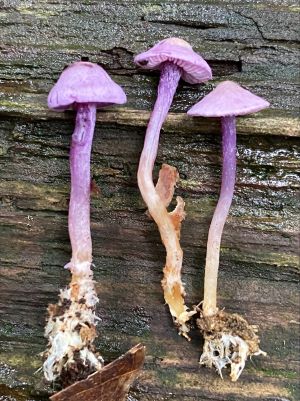
“In the summer of 2019, I was using an app called Seek to photograph and log every
species of plant I could when one hike changed everything. The path I was hiking had
an absolutely mind-blowing assortment of fungi—bright orange and gold speckled Amanitas,
huge red and purple boletes—and I had to photograph them and find out what they were.”
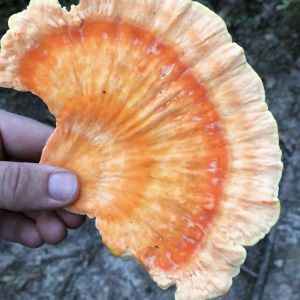
Zoeller said he is especially devoted to polypores, “wood-devouring fungi that usually
form shelves or brackets on trees, stumps, and sticks,” and crust fungi, which look
like a thin crust of material clinging tightly to wood, that “many are quick to call
boring.”
When asked how many times he has heard a "fun-guy" joke, he said that number is approaching
50, “which matches the number of groans and eye rolls I've made in response.”
Since becoming involved with the Bluegrass Mycological Society three years ago, Zoeller
has been a hike leader and educator. “We identify fungi, lead hikes and teach classes
for everyone from Scout troops to Kentucky's state park rangers.”
He has also connected with Bellarmine faculty who are interested in fungi, in particular
Dr. Joe Jareczek (Biology), Dr. Mary Kroetz (Biology) and Dr. Kate Bulinski (Environmental
Studies). “I've been consulting him to help design a mycology course to offer here
at Bellarmine, and his insights have been invaluable in that process,” Jareczek said.
Bulinski said faculty hope to capitalize more on Zoeller’s expertise in the future,
perhaps by organizing a mushroom identification hike or hosting a public lecture about
the ecology of mushrooms.
Zoeller has also recently taken up drawing illustrations of fungi.
“I've dabbled in art my whole life, just sculpting, painting or drawing for fun,”
he said. “Prior to giving fungi a try, I was primarily drawing characters and scenes
from my favorite anime shows. The Southeast Rare Fungi Challenge folks were looking
for someone who could draw promotional artworks of fungi, and it sounded fun, so I
gave it a shot!”
He has already produced seven of an expected 20 illustrations of rare fungi to be
featured in the project, which is a regional effort to identify, document and study
rarer species that may be at risk.
Zoeller’s passion for fungi has led to new friendships. “I met some good friends years
ago as total strangers in the woods, where we geeked out about some edible American
Caesar's mushrooms together,” he recounted. “It's a community full of insanely kind,
wacky and ‘genuinely themselves’ people. I’m sure there are more mushroom nerds out
there on campus.”
Zoeller suggests that anyone who wants to learn more about mycology should connect
with local organizations by joining Facebook groups or emailing the Bluegrass Mycological
Society to subscribe to their newsletter. He also said, “Take walks and look for fungi!
It can be intimidating when you find out how diverse they are, but there are lots
of people out there that are happy to help you identify them.”
“I want people to know how vast and incredibly important fungi are to us and our planet
in ways you wouldn't expect…how staggeringly diverse they are in how they look and
behave,” he said. “And how much more I've come to value nature, life and even other
people just by studying a bunch of mushrooms!”