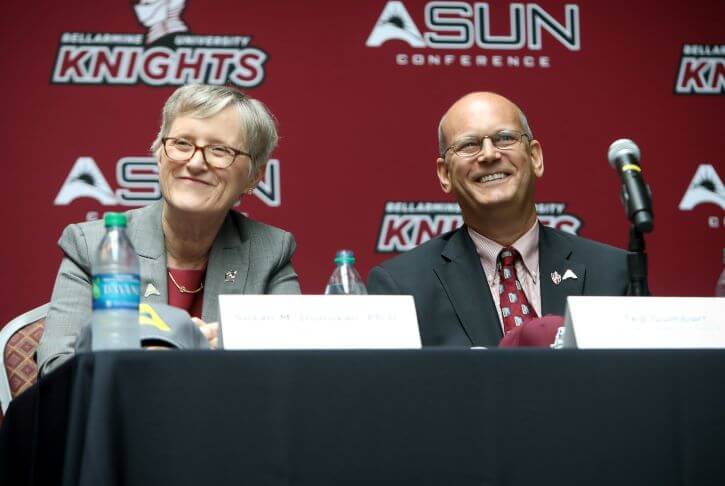
 SportsCenter, meet Knights Nation.
Board of Trustees Chair Bill Mudd called attention to the power of such exposure by referencing Bellarmine’s NCAA Division II men’s basketball national championship in 2011. Following that nationally televised game, searches and inquiries from prospective students spiked. “With the move to Division I, we no longer have to wait for a national championship to play on the national stage,” he said.
Thanks to a significant number of DI schools in the region, moving to the ASUN also means that Bellarmine will be able to schedule more compelling non-conference games, perhaps even against universities such as Louisville, Kentucky, Western Kentucky or Indiana. Bellarmine will be the 10th member, and the fifth private university, in the ASUN Conference, whose members are spread across seven mostly southeastern states, from Florida to New Jersey—areas where the number of traditional college-age students is growing. “As a Division I school, we will be able to share all that Bellarmine has to offer with a larger audience than ever before, through increased media coverage and event attendance,” Dr. Donovan said. “This will allow us to recruit excellent students from a much wider geographic area... and increase the diversity of our student body.” Academics will remain Bellarmine’s top priority, she added. Division I maintains even more rigorous academic standards than Division II—standards that Bellarmine student-athletes already meet or exceed. “Bellarmine is going to The Show,” said Athletic Director Scott Wiegandt, a two-time
Bellarmine graduate, former professional pitcher and former BU baseball coach who
has been AD since 2006. “In every way, this transition is the next
natural step. In 1985 I came here as a freshman. I experienced Bellarmine College
at its fullest. I came back as a professional to coach at what transitioned into Bellarmine
University. So this, it really seems like just the next part of the foundation
of Bellarmine’s future… But what is most exciting to me is that, like Bellarmine,
the ASUN puts students first. That’s why I came to Bellarmine. I was a biology major.
Sure, I came here to play baseball, but it was about getting
that degree, because I wanted to expand the field of play beyond my four years. Our
student athletes are challenged academically, socially and athletically, and that’s
how we are going to recruit. We’re going to do this with Bellarmine-profile
student athletes. This will be Bellarmine’s version of Division I.”
“Bellarmine is going to The Show,” said Athletic Director Scott Wiegandt, a two-time
Bellarmine graduate, former professional pitcher and former BU baseball coach who
has been AD since 2006. “In every way, this transition is the next
natural step. In 1985 I came here as a freshman. I experienced Bellarmine College
at its fullest. I came back as a professional to coach at what transitioned into Bellarmine
University. So this, it really seems like just the next part of the foundation
of Bellarmine’s future… But what is most exciting to me is that, like Bellarmine,
the ASUN puts students first. That’s why I came to Bellarmine. I was a biology major.
Sure, I came here to play baseball, but it was about getting
that degree, because I wanted to expand the field of play beyond my four years. Our
student athletes are challenged academically, socially and athletically, and that’s
how we are going to recruit. We’re going to do this with Bellarmine-profile
student athletes. This will be Bellarmine’s version of Division I.”
A possible move to Division I had been discussed for some time. Former President Joseph J. McGowan first looked into DI possibilities in 2001, and Bellarmine established its DI lacrosse program in 2005. This most recent exploration arose during the extensive, 12-month strategic planning process that President Donovan began in January 2018 and that involved significant input from faculty, staff, alumni, students and other community stakeholders. Expanding Bellarmine’s geographic reach and impact became a consistent theme of these discussions.
 Studies of conference realignment typically involve a great deal of confidential one-on-one
negotiation. A school must accept a conference invitation that must then be approved
by the NCAA. No conference wants to run the risk of inviting a school to join
only to be publicly rejected. Similarly, no institution wants to announce publicly
its intent to make the transition to DI, only to find there is no invitation being
offered. For those reasons, Bellarmine proceeded through the preliminary discussions
with utmost care. The ASUN vote to accept Bellarmine was unanimous. Now the news
is out, in a big way. And the whole city is celebrating. Noting that Louisville had
just celebrated Muhammad Ali Week, Mayor Greg Fischer declared at the news conference:
“This is a very Ali-like move that Bellarmine is making here. Going big, saying we’re
gonna be the biggest at what we want to
do and take on greater challenges.” Then he took a peek into the future (following
the four-year transition period the NCAA requires before NCAA Tournament play). “Think
about CBS Selection Sunday, to hear the name ‘Bellarmine Knights’ called. To see Scotty
Davenport, calm and reserved and emotionless while that [announcement] is made, will
be a wonderful thing to see ... This is just a beautiful
seed of success that is being planted for Bellarmine and our city today.”
Studies of conference realignment typically involve a great deal of confidential one-on-one
negotiation. A school must accept a conference invitation that must then be approved
by the NCAA. No conference wants to run the risk of inviting a school to join
only to be publicly rejected. Similarly, no institution wants to announce publicly
its intent to make the transition to DI, only to find there is no invitation being
offered. For those reasons, Bellarmine proceeded through the preliminary discussions
with utmost care. The ASUN vote to accept Bellarmine was unanimous. Now the news
is out, in a big way. And the whole city is celebrating. Noting that Louisville had
just celebrated Muhammad Ali Week, Mayor Greg Fischer declared at the news conference:
“This is a very Ali-like move that Bellarmine is making here. Going big, saying we’re
gonna be the biggest at what we want to
do and take on greater challenges.” Then he took a peek into the future (following
the four-year transition period the NCAA requires before NCAA Tournament play). “Think
about CBS Selection Sunday, to hear the name ‘Bellarmine Knights’ called. To see Scotty
Davenport, calm and reserved and emotionless while that [announcement] is made, will
be a wonderful thing to see ... This is just a beautiful
seed of success that is being planted for Bellarmine and our city today.”
Read more about the move to Division I.
Written by Carla Carlton
First, it is important to note that a conference must invite a school to join, and if that invitation is accepted, then the formal application is made to the NCAA to move to DI. We wanted a conference partner that would help realize the priorities of the strategic plan—including providing a transformative student experience, expanding our geographic reach and impact and demonstrating commitment to equity and inclusion.
Will all of Bellarmine’s sports have a home in the ASUN Conference?Bellarmine fields 17 sports sponsored by the ASUN Conference. Additionally:- Men’s lacrosse, which has been a DI program since 2005, will continue as a member of the Southern Conference.
- Men’s and women’s swimming will participate in the Coastal Collegiate Sports Association.
- Field hockey and wrestling will compete in DI with independent status.