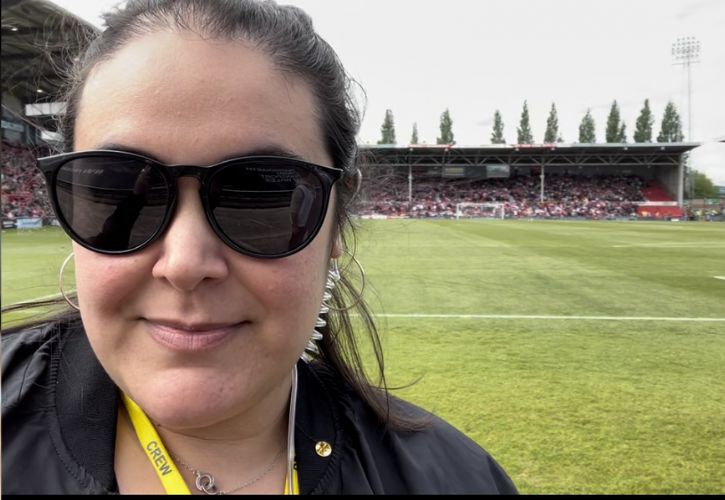
As a senior production supervisor with Boardwalk, she spent two years in Wales working on Welcome to Wrexham, a 2022 docuseries chronicling the purchase of the professional football club Wrexham AFC by actors Ryan Reynolds and Rob McElhenney.
Risk-taking seems to be part of her DNA. Carroll’s first job out of college was with LeapFrog Interactive (now LEAP), a pioneering digital agency in Louisville. “I was working in digital marketing at a time when the iPhone was just kind of taking flight and when iPads became a thing,” she says. “They were such a future-forward company that we were developing content in a world that just didn't exist.” After volunteering at a film festival in Louisville and working as a production assistant on a film and two commercials locally, she made the “leap” to Los Angeles. When we spoke*, she was preparing to serve as a field producer for an upcoming travel/food show on a major streaming platform. “I don't think that I'd always had plans to go to LA necessarily, or even work in entertainment specifically; I just knew that I wanted to do something creative,” she says. “If you had asked me when I was 10, I would have said, ‘I'm gonna be a singer.’ But I have a terrible voice. Bellarmine helped me really fine-tune the idea of possibility.”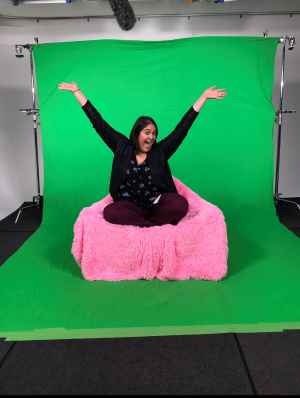 Why make the move from digital marketing to movies? Part of LeapFrog’s philosophy was community outreach: Get out there and hone your
skills, start volunteering with other people—you never know what kind of business
you can bring in. I didn't go to film school, but I wanted to see what it's like to
be part of a film festival. There were a couple of festivals that happened in Kentucky.
I emailed one and said, “I'm in digital marketing. I would love to volunteer doing
whatever you all need.” I was just going to do social media, but I ended up taking
on way more. I was a talent liaison; I was recruiting and managing the volunteer base;
I was doing donor relations and working with the vendors. And they were like, You have to come to LA. So in June 2011, I visited LA for two weeks as a trial run. I was 25 at the time,
and I remember saying to myself, If you're gonna make a move, it's gotta be now. I wanted to do it before I turned 26 for whatever reason. I guess the trial run was a success. I came back and told my mom, “That's it. I'm gonna move to LA.” I gave six months’
notice at LeapFrog. I drove from Kentucky to California by myself in my little 2008
RAV4. I left the day after Christmas 2011 and arrived right before New Year’s. That
first year, 2012, I had something like 13 or 14 gigs, so I remember tax season in
2013 was absurd. It was a very rough start, but I had friends coming out to visit
me and lots of care packages from home. It was a little crazy. But Bellarmine definitely
prepared me for that. How so? I didn't have the traditional college experience. I didn't stay on campus, so I didn't
have that immersion in dorm life. I didn't do the partying college experience. I did
the ‘try everything, do everything, be everywhere’ college experience. Those smaller
class sizes gave me more intimate relationships with friends and, more importantly,
with faculty like Dr. Gail Henson, who kind of took me under her wing. On a smaller
campus, you have access to more things, and there’s just so much opportunity. For
example, they said, We’ve got this radio station but it's kind of fledgling and it's not really doing
much. Do you want to help revive it? So here I am, creating this pitch to go into SGA [Student Government Association]
with a couple of other people and ask for $20,000—and they gave it to us. And we picked
the station manager and the music director. Bellarmine gave me opportunity—and more
importantly, the ability to recognize opportunity. What is the most exciting project you've worked on? It’s hard to narrow it down to one. But the Welcome to Wrexham project was great because I worked with major celebrities and got to travel. That
show saved my butt during the pandemic. We shut down in March 2020. But entertainment
is one of the only industries where not only did we come back, we boomed, because
everybody was at home consuming content faster than the studios could make it. They
were like We need to do this entire show that would normally have 15 to 20 people on set every
day, and now we need to do it with less than 10. Again, opportunity, right? I was able to do so much more than I normally would have
been asked to do or allowed to do. What advice would you give someone about pursuing a career like yours? There are two big things for me. One of them is super-straightforward and easy to
do: volunteer. I have gotten more opportunities through volunteerism than I have from
any job I’ve ever worked. You learn so much more about yourself. You discover so much
more flexibility in this idea of what you can and can’t do. The other one is more
like a life motto: If you want to try something new, do it. I don't know how else
to say it. Some people get stuck in this kind of self-fulfilling prophecy of, Yeah, I want to do that, but I don't have any money. I don't have any time. I don't
have any experience. I don't know the people. There are other ways to go about it. Stop putting boundaries on yourself. Just try
little steps—create those opportunities for yourself. I know this is so much easier
said than done but stop putting limitations on yourself. Because it really is amazing
what you're able to do. *This interview has been edited and condensed.
Why make the move from digital marketing to movies? Part of LeapFrog’s philosophy was community outreach: Get out there and hone your
skills, start volunteering with other people—you never know what kind of business
you can bring in. I didn't go to film school, but I wanted to see what it's like to
be part of a film festival. There were a couple of festivals that happened in Kentucky.
I emailed one and said, “I'm in digital marketing. I would love to volunteer doing
whatever you all need.” I was just going to do social media, but I ended up taking
on way more. I was a talent liaison; I was recruiting and managing the volunteer base;
I was doing donor relations and working with the vendors. And they were like, You have to come to LA. So in June 2011, I visited LA for two weeks as a trial run. I was 25 at the time,
and I remember saying to myself, If you're gonna make a move, it's gotta be now. I wanted to do it before I turned 26 for whatever reason. I guess the trial run was a success. I came back and told my mom, “That's it. I'm gonna move to LA.” I gave six months’
notice at LeapFrog. I drove from Kentucky to California by myself in my little 2008
RAV4. I left the day after Christmas 2011 and arrived right before New Year’s. That
first year, 2012, I had something like 13 or 14 gigs, so I remember tax season in
2013 was absurd. It was a very rough start, but I had friends coming out to visit
me and lots of care packages from home. It was a little crazy. But Bellarmine definitely
prepared me for that. How so? I didn't have the traditional college experience. I didn't stay on campus, so I didn't
have that immersion in dorm life. I didn't do the partying college experience. I did
the ‘try everything, do everything, be everywhere’ college experience. Those smaller
class sizes gave me more intimate relationships with friends and, more importantly,
with faculty like Dr. Gail Henson, who kind of took me under her wing. On a smaller
campus, you have access to more things, and there’s just so much opportunity. For
example, they said, We’ve got this radio station but it's kind of fledgling and it's not really doing
much. Do you want to help revive it? So here I am, creating this pitch to go into SGA [Student Government Association]
with a couple of other people and ask for $20,000—and they gave it to us. And we picked
the station manager and the music director. Bellarmine gave me opportunity—and more
importantly, the ability to recognize opportunity. What is the most exciting project you've worked on? It’s hard to narrow it down to one. But the Welcome to Wrexham project was great because I worked with major celebrities and got to travel. That
show saved my butt during the pandemic. We shut down in March 2020. But entertainment
is one of the only industries where not only did we come back, we boomed, because
everybody was at home consuming content faster than the studios could make it. They
were like We need to do this entire show that would normally have 15 to 20 people on set every
day, and now we need to do it with less than 10. Again, opportunity, right? I was able to do so much more than I normally would have
been asked to do or allowed to do. What advice would you give someone about pursuing a career like yours? There are two big things for me. One of them is super-straightforward and easy to
do: volunteer. I have gotten more opportunities through volunteerism than I have from
any job I’ve ever worked. You learn so much more about yourself. You discover so much
more flexibility in this idea of what you can and can’t do. The other one is more
like a life motto: If you want to try something new, do it. I don't know how else
to say it. Some people get stuck in this kind of self-fulfilling prophecy of, Yeah, I want to do that, but I don't have any money. I don't have any time. I don't
have any experience. I don't know the people. There are other ways to go about it. Stop putting boundaries on yourself. Just try
little steps—create those opportunities for yourself. I know this is so much easier
said than done but stop putting limitations on yourself. Because it really is amazing
what you're able to do. *This interview has been edited and condensed.