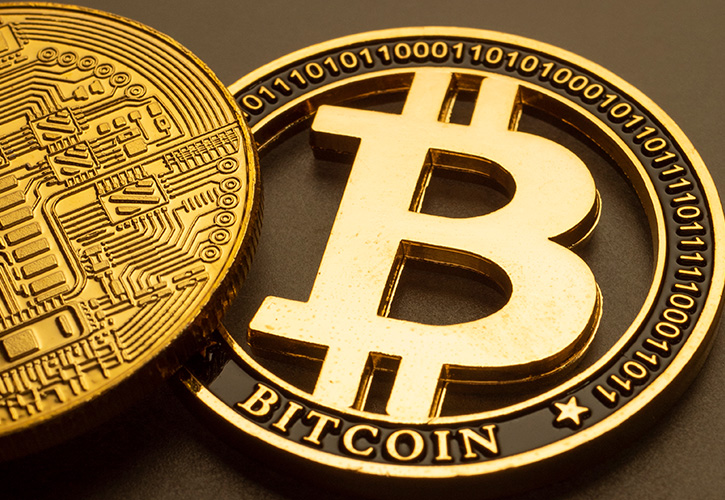
By David T. Collins, Ph.D. The public is fascinated by Bitcoin and other cryptocurrencies.
Part of the mystique is that cryptocurrencies are not well understood and therefore
seem magical. Part is the dream that, like gold, bitcoin can be mined. Part is the
thrill of being connected
with something associated with illicit activity on the dark web.
Setting the mystique aside, cryptocurrencies are computer files that are called “wallets”
but function more like a safety-deposit box: They contain data about the amount of
currency you own, along with your public and private keys. The public
key is essentially the address of your wallet and allows you to receive cryptocurrency.
The private key is your password, which allows you to access your cryptocurrency.
As of January 2022, it was estimated that more than 8,000 cryptocurrencies exist.
Most are less than $10 per unit, and much of the rest are less than $500. Other than
Bitcoin, only Ethereum (valued at greater than $3,000 per unit) and Maker (over $2,000)
have a significant value. Bitcoin was not the first cryptocurrency, but it is the
best-known and the most valuable. Its value on Jan. 18, 2022 was $42,900 per coin,
and it hit a recent high of $67,500 on Nov. 8, 2021.
Bitcoin was started on Jan. 3, 2009, when Satoshi Nakamoto (believed to be a pseudonym)
created the first, or genesis, block (“Block 0”) and received 50 bitcoins.
Like/unlike other cryptocurrencies, Bitcoin is payment for the work required to verify
and add a block to the blockchain network. A blockchain is a peer-to-peer distributed
network (readers of a certain age will recognize Napster or Kazaa as examples
of so-called P2P networks, in contrast to the more common client-server model) that
stores data in blocks. These blocks are linked together—to be added to the chain,
each block must be verified with a mathematical hash (a specific complex number)
that connects the new block to the previous block.
Every time a new block is added, or mined, the miner who computed the correct hash
receives bitcoins. At first it was 50, but then that was halved to 25, and then halved
again to 12.5. The most recent halving was on May 11, 2020, and payment is now 6.25
bitcoins. (Halving happens every four years.) There is an absolute limit of 21 million
bitcoins. To date, 18 million have been mined, and it is estimated that the last bitcoin
will be mined in 2140.
In the early days, a typical desktop PC was powerful enough to mine bitcoins, which
allowed pretty much anyone to try mining. These days the computers required are specialized
and massive. In October 2019, it required 12 trillion times more computing
power to mine one bitcoin than it did when Nakamoto mined the first blocks in January
2009. As a result, modern bitcoin mining consumes massive amounts of electricity—so
much that some governments identify miners and charge them special rates or even curtail
access to power. In response, dark-web sites use spam bots to create
anonymous miners that are difficult to trace. The spam bots infect unsuspecting computers
to create large bitcoin-mining networks using someone else’s power. Readers may want
to know if this could happen to them.
Because it is difficult for the average person to mine bitcoin, the easiest way to
own bitcoin is to purchase it. Bitcoin is now treated as a commodity investment, and
online exchanges have opened to provide a marketplace for cryptocurrencies. All
cryptocurrencies are very volatile and, like other risky investments, they are not
for the faint of heart.
According to Ollie Leech, an editor at CoinDesk, a bitcoin online exchange, cryptocurrency
volatility is due mostly to the immature market. “Traders are very susceptible to
emotion and fear and greed, and so you get these really extreme market reactions.”
And then there’s social media. “It’s this weird new thing where viral social trends,
like Wall Street Bets or Elon Musk, for example, have a huge influence over crypto,”
Leech says. “If Elon Musk puts #Bitcoin in his
Twitter bio, it sends Bitcoin up 10 percent.”
If you want to add cryptocurrencies to your investment portfolio, the general rule
of thumb is a range from 5 percent (very conservative) to 50 percent (very risky),
with a moderate range between 15 and 20 percent. As with other investments, the mantra
is “Buy low, sell high.” You want to time your purchases when the cryptocurrency is
at the low end of its recent price range. And because of its volatility, you should
view your investment as a long-term hold strategy.
Governments around the world, including the United States government, have classified
cryptocurrencies as commodities, and they are subject to the same capital gain taxes
as more traditional investments. (TurboTax and others already have added cryptocurrency
gains and losses to their tax preparation software.) So, you’ll need to factor the
tax impact into your investment decisions.
By Steve Brown ’01 In 1997, I was starting my freshman year at Bellarmine. There
was no internet access in the dorm rooms. Google, Amazon, Netflix and TikTok did not
yet exist. Neither did Bitcoin, which would not appear for another 12 years.
Today, there are approximately 130 million Bitcoin users worldwide, and experts predict
that number will swell to more than 1 billion in the next five years. Should you become
one of them?
I can tell you that for me, using something new requires a level of trust. I trust
computers, math and cryptography. While understanding Bitcoin may be difficult, it
has worked without incident since 2009. I trust that the Bitcoin protocol is immune
to
direct control by any individual, government or bank because it is secured by the
distributed consumption of energy, making it virtually impossible to compromise. Bitcoin
is open source; its design is public; nobody owns or controls it and everyone
can take part.
Bitcoin allows anyone to be in full control of their stored value. Users can transact
at any time, from anywhere, for any amount, with anyone on the network. There’s no
need for a bank and no need for the user to be identified. If used properly,
it would be extremely difficult to trace down a bitcoin transaction’s physical source
or destination. Bitcoin can also handle programmable smart contracts that will be
executed only when specific conditions are met, like releasing the title
of your home when the agreed-upon balance is placed in your Bitcoin wallet.
Soon, microtransactions will become more prevalent online, each costing a fraction
of a bitcoin and processed in real time or as a part of a smart contract. For example,
news outlets could charge for each article consumed instead of relying on monthly
contracts or advertising. These instant, nearly free transactions will later progress
into the physical world. Your groceries could be paid for as they go into the cart
and tolls by the mile. Bitcoin is secure, programable money.
We are still in the very early stages of the adoption of this technology, and the
learning curve is steep. If you are interested in investing, be patient. Learn how
to acquire bitcoin and store it properly in a hardware wallet. Transfer only as much
value
as you are comfortable storing in a technology you may never fully understand.
Dr. David T. Collins is a professor of Accounting in the W. Fielding Rubel School
of Business at Bellarmine University. He received his Ph.D. at Georgia State University
and has been teaching for 40 years.
Steve Brown ’01 is a founding partner of 13Prime, a business software and technology
company in Louisville.
What is cryptocurrency... and should you invest in it?
What is cryptocurrency... and should you invest in it?
May 19, 2022