Bachelor of Arts in Economics
Study Economics for Many Career Paths
Program Overview
An Economics degree from Bellarmine prepares graduates for careers in business, government, and beyond. You’ll develop strong analytical skills while gaining real-world experience through our internship guarantee and strong local partnerships.
Why earn your Economics degree at Bellarmine?
Bellarmine’s Economics program develops the analytical tools employers value and prepares students for graduate study in fields such as finance, public policy, and law. The program also regularly places students into master’s and Ph.D. programs in economics.
While not required, most economics majors complete internships and one-third study abroad. Because the economics program is flexible, many students may also pursue a double major or minor in disciplines such as history, English, philosophy, political science, actuarial science, and many more.
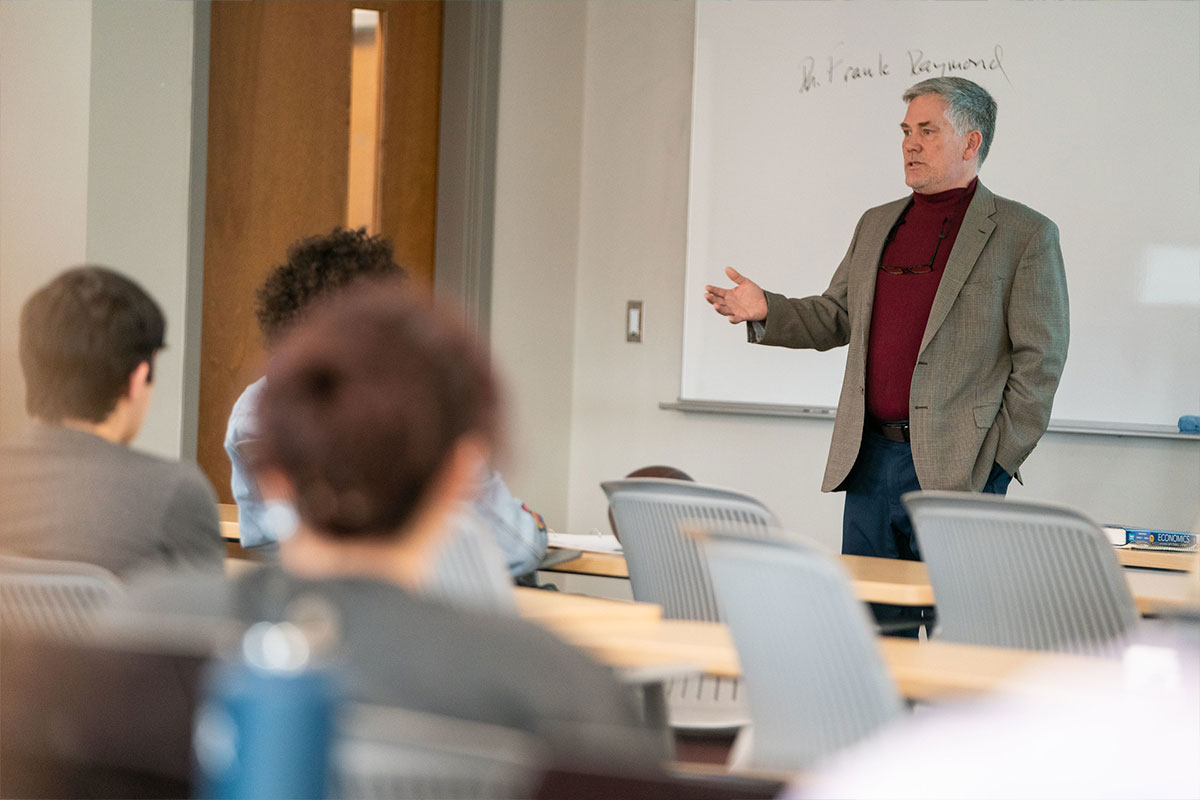

Internship Guarantee and Strong Local Connections
Bellarmine’s Economics program builds the analytical skills employers seek while preparing you to understand complex economic issues. Our internship guarantee and strong local partnerships ensure you gain hands-on experience that leads to career opportunities.

Global Learning and Graduate Pathways
Economics students expand their perspective through study abroad opportunities and global learning experiences. With careful planning, you can also combine your undergraduate Economics degree with an MBA in just five years.

When I arrived at Bellarmine as a freshman, I expected a great education — but I never imagined how much I would grow. Through admissions work, service trips, and campus involvement, I discovered my passion for helping others. Today, I use my Math and Economics degree to consult with companies on human resources issues. Bellarmine pushed me to embrace my liberal arts education, and I couldn’t be more grateful.
LaCinda Glover, Mathemathics and Economics, Mercer
Top 6%
Elite AACSB-Accredited
2/3
Economics Majors Pursue Internships
1/3
Economics Majors Study Abroad
Frequently Asked Questions
Do you provide job or internship placement?
Yes. Bellarmine guarantees every student the opportunity to have an internship, develop a career plan, and build a professional network. A sizeable percentage of Economics majors pursue internships at local businesses or government internships in Frankfort or Washington. Internship opportunities are available at a number of notable businesses, including Morgan Stanley, National City Bank, The Stevenson Company, Summit Energy, General Electric, William Mercer, and Constellation Energy.
Are there any special requirements to remain in the program?
Yes. Students must achieve a minimum 2.00 GPA for all Rubel School courses (Accounting, Business, Economics, and Finance) taken in the Rubel School (not counting transfer courses) to graduate with an Economics major.
How many hours can I expect to spend studying outside of class time?
Students have their own learning styles so this can vary greatly. As a rule of thumb, expect to spend an average of two hours studying for every hour you spend in class.
Career Opportunities
Students with undergraduate or advanced degrees in Economics may pursue a wide range of careers in both the private and public sectors. Private-sector opportunities include jobs in areas such as banking, finance, economic forecasting, energy management, insurance, real estate, marketing, data management, general management, and research and development. Opportunities in the public sector include jobs at the local, state, or federal level of government or with organizations such as the Federal Reserve Bank. Many of our graduates have earned permanent positions at these companies. Some graduates have gone on to become entrepreneurs.
Some of our recent graduates have chosen to complete law degrees or other doctoral degrees. The Rubel School faculty take an active role in helping to place students in internships and in helping to identify suitable opportunities for permanent employment or graduate school.
On-Campus Experiences
Omicron Delta Epsilon (ODE) is the International Economics Honor Society. A primary objective of ODE is to provide recognition for those students who have achieved academic excellence in their Economics courses. In addition, ODE helps to emphasize the professional aspects of economics as a career field for service in the academic world, business, government, and international organizations. Another important objective is to establish closer ties between students and faculty in Economics within colleges and universities and among other colleges and universities.
Delta Sigma Pi (DSP) is a professional co-ed fraternity organized to foster the study of business in universities; to encourage scholarship, social activity, and the association of students for their mutual advancement by research and practice; to promote closer affiliation between the commercial world and students of commerce; and to further a higher standard of commercial ethics and culture and the civic and commercial welfare of the community.
The Economics and Finance Club provides Economics majors with opportunities to hear speakers from the fields of economics and finance. There is also an annual opportunity for students to attend a professional conference. Additionally, members will have the opportunity to participate in community and university service that uses their expertise in economics and finance.
Study Abroad Opportunities
Student Organizations
Faculty
| Name | Title | Phone | |
|---|---|---|---|
| Dr. Frank E. Raymond | MBA Director | fraymond@bellarmine.edu | (502) 272-8487 |
| Dr. Hongwei Song | Assistant Professor of Economics | (502) 272-8008 |
Bellarmine on Business Podcast
Bellarmine University's Rubel School of Business produces the Bellarmine on Business podcast. Each monthly episode features lively discussions with faculty and/or alumni. Episodes focus on the economy, finance, marketing, HR, the law, business strategy, and more.
Degree Requirements
For an Economics Major:
- Required Core Courses: ECON 110, ECON 111, 231, 232, 314, 410, 441, 499, and six hours selected from other 300- or 400-level courses in Economics.
- Required Related Courses: MATH 205 or 315 and 125 or 117.
- For the maximum of 36 hours permitted in the department, nine additional hours may be selected from other courses in Economics.
For an Economics Minor:
- ECON 110, 111, 231, or 232, MATH 125 or 117, and an additional nine hours selected from 200-, 300-, or 400-level courses in Economics.
- Note: Finance majors who minor in Economics must take an additional 300- or 400-level Economics course. If they choose ECON 231 and ECON 410, then ECON 410 can count as a substitute for BUSA 346 in the Finance major as well.
Costs and Aid
Contact
Bradley Stevenson, Ph.D.
Department Chair
bstevenson@bellarmine.edu
502.272.8173
Take Your Next Step
Start your Bellarmine story. Request information today.
Request InformationCome to campus and see what Bellarmine hospitality is all about.
Schedule Your Visit