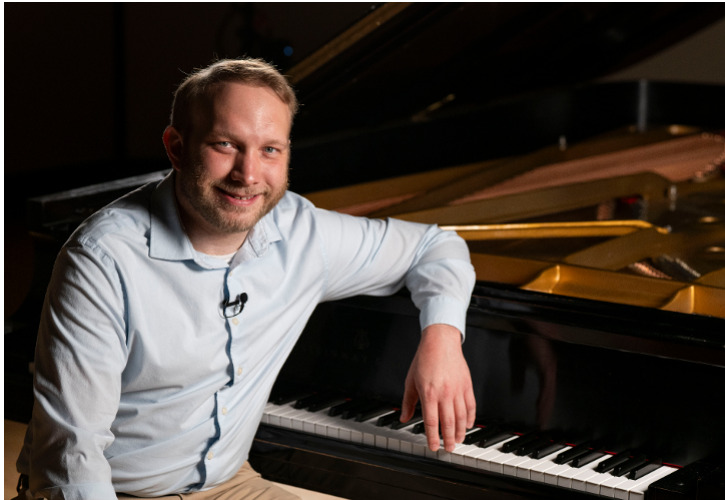
By Carla Carlton As an assistant professor of Piano and Music Theory, Dr. Louie Hehman
’14 helps Bellarmine music majors prepare for recitals in their junior and senior
years. But on a Sunday in late September, Hehman himself was under the lights of the
Cralle Theater stage. At 3 p.m., he walked out, took a seat at the Steinway Model
D piano and paused for a moment, collecting himself. Then he began to play Duke Ellington’s
Sophisticated Lady, followed by the composer’s
Black Beauty.
Spiritual Suite by Margaret Bonds concluded the program’s first half. As he played, Hehman’s eyes
were closed, and at times he bent close to the keys. After a short intermission,
he was back for the featured piece:
Carnaval, the famously difficult, 28-minute masterwork of Robert Schumann. Composed between
1834 and 1835, the work for solo piano has 21 movements that collectively cover the
full range of human emotion. Each movement depicts a character at an imaginary masked
ball. A series of humorous illustrations projected on a screen above the piano helped
listeners keep track of the characters’ entrances and exits. It took Hehman more than
a year to perfect and memorize
Carnaval–a “never-ending process of repetition, listening, slowing yourself down, repetition
again, reading the score away from the piano, and then more repetition.”
While muscle memory is important, he said, even more important is cultivating aural
memory, often called audiation. “I compare it to hearing a narrator in your head while
reading a book. Over the course of the year-and-some-change I've worked on this piece
and the other pieces on this program, I’ve worked to cultivate a strong auditory image
of the music so that I can hear everything in my head before I even sit down to play.”
That skill takes years to master, and while he might be a teacher now, he said he
is still working on it. “I gave my first recital as a sophomore at Bellarmine back
in 2012, and I have tried to give at least one every year since then. Every time I
do it, every time I learn a new piece, the audiation gets a little stronger.”
The lessons of music
Although he started piano lessons when he was 6, Hehman didn’t get serious about the
piano until college. “I was mainly a jazz major. The first year, I studied with Todd
Hildreth. Then I had some classical lessons with Meme Tunnell. And Meme was the one
who made me really fall back in love with the classical music that I had been raised
with. Those lessons are where I really realized that music was what I wanted to do
with my life.” Tunnell said Hehman, who graduated in 2014 with a double major in Music
and History, was an exceptional student. “He asked all the right questions, never
shied away from a challenge, hungered to learn everything I could teach him, and easily
is one of the most stellar and hard-working students in all my years of teaching,”
she said. “I recall the moment he began to consider further studies in graduate school,
and I knew at that point he was headed for a great career as a performer and teacher.” Hehman
subsequently earned a degree in piano pedagogy from Butler University and a Doctor
of Musical Arts degree at the University of South Carolina. A big part of her decision
to retire in 2021, Tunnell said, “was knowing Louie would most likely take over. He
is everything the students and music department need in a music professor, and I am
so gratified to see how he stepped into the job and created his own ‘village.’" Hehman,
who joined the music faculty that year, is the head of Bellarmine’s keyboard area,
coordinates music theory and runs the Bellarmine University Preparatory Program, which
offers music lessons to the community. “Whether students take private lessons with
me, or they take classes with me, there are certain ‘greatest hits’ that I want them
to come away with,” he said. “I remind them, ‘Just a little over 10 years ago, I was
one of you guys. I didn't go to Juilliard, I didn't go to a conservatory. I went to
Bellarmine, and I worked really, really hard.’ So don't count yourself out, right?
If you have dreams and you are willing to put in the hard work to make those dreams
a reality, then you can make it happen. “Music doesn't just teach us to conquer difficult
passages or to work on notes and rhythms and things like that. It teaches us how to
persevere. It teaches us discipline. It teaches us patience, and it teaches us to
be okay with who we are at the moment. And if we really listen to those most basic
lessons of music, they encourage us to become not just the musicians that we want
to be, but to grow into the people that we want to be as well.”
The humanity in music
Elise Major ’23, who double-majored in Piano Pedagogy and Chemistry with a minor
in Biology, currently teaches piano for Bellarmine’s preparatory program while attending
pharmacy school in Louisville. She took several classes with Hehman, who was also
the advisor for her junior and senior recitals and her Honors thesis. “Dr. Hehman's
teaching is not only informative, but also practical,” she said. “Instead of just
lecturing to me about piano pedagogy, he hired me to teach piano lessons so I could
put the skills I was learning into practice. This also created a place for me to give
back to the community and continue to be a part of the Bellarmine music department
post-graduation.” She said he has coached her through numerous performances, often
coming to campus during summers, holidays and weekends to squeeze in extra lessons
and rehearsals. “He is a role model of professionalism and musical excellence, approaching
everything he does with great artistry and intellectualism,” she said. “I am a better
student, a better musician, a better teacher, and a better person because of Dr. Hehman’s
investment in my life.” As a performer, Hehman is interested in the intersection
of traditional repertoire with new music, particularly works by lesser-known and marginalized
composers. He pointed to his September recital, which combined early 20th century
standards by jazz great Ellington and the Black spiritual-inspired movements of Bonds’
Spiritual Suite with the classical
Carnaval. “Music teaches us about the oneness of humanity. That sounds very grandiose. But
what's beautiful is, these are all people that led very, very different lives from
one another, maybe lived centuries apart, but still have some kind of emotional resonance
to this day,” he said. “And if there's any kind of fundamental truth that music teaches
us, it’s that all people, regardless of when they lived, or where they lived, or who
they are, or who they love, or how they identify, or how they worship—whatever it
is, they’re all fundamentally human beings. I think that by recognizing the humanity
in music, we can grow to better recognize the humanity in one another.” Following
the
Carnaval performance in September, Hehman greeted audience members in the lobby of the Wyatt
Center for the Arts. They included faculty, current and former students—and his mentor,
Meme Tunnell, who gave him a hug. “I so enjoyed hearing him perform,” she said.