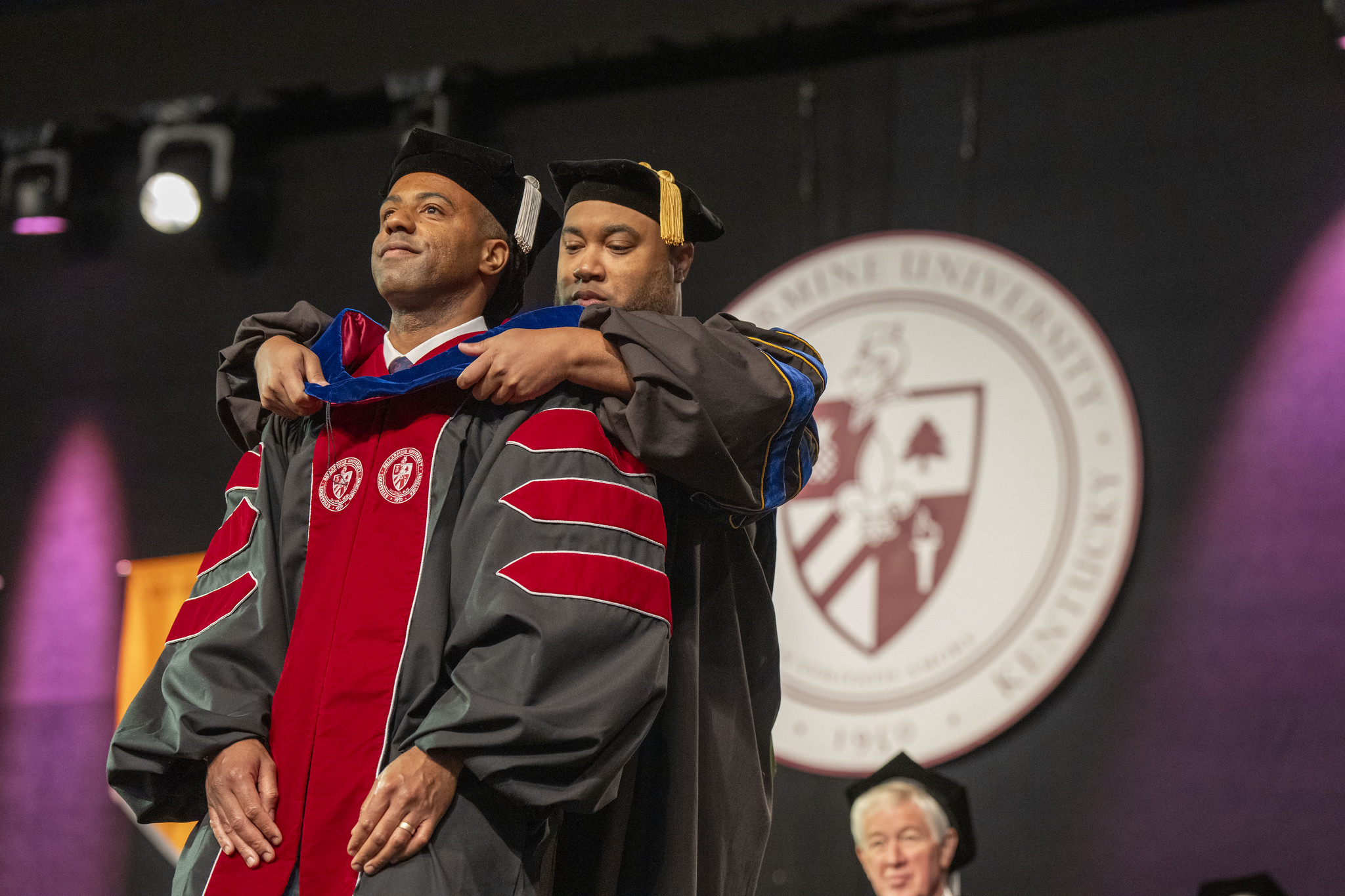
Have you been thinking about getting a doctorate in Education? Maybe you've been thinking about it for years, or maybe someone recently suggested it and now you can't quite get the idea out of your head. Maybe you’re looking to move up the teacher pay scale, to get promoted, to make a career shift, or to more deeply explore a topic you care about. Either way, you've probably encountered two options: the Ph.D. and the Ed.D.
Ph.D. vs. Ed.D.: What's the difference?
The Ph.D. has been around longer, with that degree awarded starting in Germany in the 1650s. The Ed.D. is a bit newer, first granted from Harvard in the 1920s. The Ed.D. is an applied, practitioner-focused degree, initially conceptualized as a professional degree for school administrators and educational leaders rather than a traditional academic Ph.D. The idea of a professional doctoral degree exists in several disciplines, such as in medicine (M.D.) and law (J.D.).
Both the Ph.D. and Ed.D. are doctoral degrees. Both require serious reading, writing, and thinking. And both can open doors professionally. But they tend to approach education from slightly different angles.
The Carnegie Project on the Education Doctorate describes the Ed.D. as a degree designed to prepare scholarly practitioners. These are educators and leaders who use research to address problems of practice in their schools, districts, universities, and communities. They're interested in taking what the discipline already knows through empirical research and putting it to work in their own contexts.
A Ph.D., on the other hand, is traditionally a research degree. Rather than focusing primarily on applying existing research to a problem of practice, Ph.D. students learn how to design and conduct original research that contributes new knowledge to the field. At Bellarmine, Ph.D. students take five formal research methodology courses and many more that emphasize educational policy, applying theoretical frameworks, and crafting literature reviews, and then craft their dissertation study under the mentorship of a faculty member.
Take this imperfect example: An Ed.D. student might ask, "How can we improve teacher retention in my district?" A Ph.D. student might ask, "How do teachers describe the experiences that influence their decisions to stay in or leave the profession?"
See the difference? Same general concern, but different questions. Both are worth asking.
Of course, there's overlap. Ed.D. students conduct research, and Ph.D. students care deeply about what happens in actual classrooms. These aren't hard-and-fast categories, but they can help you think about which path makes the most sense for you.
Why get a Ph.D.?
People sometimes assume that getting a Ph.D. means you want to become a professor, but that's far from the only possibility. A Ph.D. in Education prepares you to become a researcher. That means learning how to ask good questions, figuring out how to answer them, making sense of what you find, and sharing that knowledge with others.
Maybe you're a classroom teacher who's noticed something happening with your students that you can't quite explain. Maybe you're a school leader who keeps running into the same challenge and wants to understand why. Or maybe you've been reading educational research for years and find yourself thinking, "But what about...?" That curiosity is a pretty good place to start.
Graduates of our Ph.D. program work in higher education, school districts, nonprofit organizations, government agencies, research centers, and educational organizations. Some become professors while others work in curriculum development, policy, program evaluation, educational leadership, or research. One is an elected state representative in Kentucky, where she champions public education. The common thread isn't necessarily a particular job title, it's a desire to understand education more deeply and contribute something meaningful to what we know.
For better or worse, sometimes that means discovering that the question you started with wasn't quite the right question after all. That's part of the fun (or at least part of the process).
Why this Ph.D.?
There are plenty of doctoral programs out there, and choosing one is a big decision. At Bellarmine, we've built our Ph.D. in Education and Social Change around a pretty simple idea: rigorous doctoral study should be possible for people who already have full, busy lives. Here are some benefits of our program:
1. You don't have to put your career on hold.
Our program is designed for working professionals. While there are several programs that offer a fully online Ed.D., fully online Ph.D. programs are less common, and we’re very proud of ours. Most of your coursework happens asynchronously, which means you can do the reading, writing, and learning around your existing schedule. You'll also meet virtually with your professors and classmates throughout the semester, and you'll come to campus for a long weekend each summer.
That summer experience is one of our favorite parts of the program. It's a chance to get to know the people you'll be learning alongside, spend time with faculty, and feel like part of a scholarly community. By connecting with your cohort, your faculty, and our campus, you can feel connected to Bellarmine from the very beginning.
2. You're not going to get lost in the crowd.
Our cohorts are small, and that matters. Your professors know who you are, what you're interested in, and what you're working toward. Your classmates become the people who read your drafts, challenge your thinking, celebrate your successes, and understand exactly why you're excited about a really good research question.
There's something special about learning with the same group of people over time. You get to watch each other's ideas grow. And, eventually, you get to see those ideas turn into actual research. Our students research together, write together, and share silly memes together when life is exciting or stressful or anything in between.
3. Research isn't something you wait until the dissertation to do.
One of the things we love about our program is that research is at the center of the experience. We want students to see themselves as scholars early on, which means learning to think like researchers, engage with existing scholarship, and develop their own lines of inquiry. From the first semester in your doctoral research seminar, we ask you to think about research in a new way, exploring the requirements of the dissertation, some unwritten rules of academia, and a place for all of your “holy smokes I’m a Ph.D. student, what now?!” questions.
By the time you reach your dissertation, you've already spent meaningful time thinking about research questions, methodologies, and the kinds of contributions you want to make, and you’ll know your faculty well enough to make an informed decision about who you’d like mentoring you through that process.
4. There's room to follow your interests.
Education is a big field. Really big. And the questions that matter to one doctoral student might look completely different from those that matter to another.
Our curriculum gives students room to explore their own scholarly interests while developing a strong foundation in educational research. Maybe you're interested in literacy, teacher preparation, leadership, policy, or something else entirely. We want you to have opportunities to connect what you're learning to the questions that brought you here in the first place.
So, is a Ph.D. right for you?
Maybe! (How's that for a professor answer?)
To really answer that question for yourself, think about what you are hoping to do with this degree. What questions keep coming up in your work? Are you interested in learning how to study those questions in a systematic, meaningful way?
A doctorate is a big commitment. It takes time, energy, and a willingness to be uncomfortable while you learn new things. But it can also change the way you see your work, your field, and yourself.
If you've been thinking about a Ph.D., I'd love for you to take a closer look at what we're doing at Bellarmine. Your questions might be exactly where your next chapter starts, and I’d love to be a part of your thinking as you make this decision. Please do not hesitate to reach out to me at the email below to learn more about our program.
Jess Smith, Ph.D.
Assistant Professor of Literacy Education
jsmith89@bellarmine.edu