by Melissa Uhl Draut
Last fall I rediscovered 14 letters written by Fr. John Loftus, Dean of Bellarmine College to me from 1967-1969. Those letters sent me on a journey to discover a man of faith, intelligence, and good humor who rose to the occasion during his time in history.
Thanks to 14 letters, I can tell his story.
When I was eight years old in 1967, I met Fr. John, then Dean of Bellarmine College at the home of my best friend Gail where he was convalescing after a hospital stay. Gail’s mother, Marge Smith, was a founding member of the Bellarmine Women’s
Council.
I had used the opening lines from his first letter for my senior yearbook quote. “On the darkest nights the stars are most beautiful. Each tiny, brilliant spot in the heavens is a joy for the heart. One sees another golden brilliance in the black
velvet sky and knows the world must be worthwhile.”
Tucked along with the cream-colored envelopes was a yellowed obituary from the Wednesday, January 8, 1969, The Louisville Times. As I read it, my thoughts ranged from “Wow, this guy was something in his day” to “When did he even
have time to be pen pals with a kid?”
He launched Bellarmine College in 1950 as the first registrar and director of student personnel and became dean in 1953. The Louisville Times described him as a “forceful presence who cropped up in all sorts of places and didn’t know the meaning
of the phrase ivory tower.” He embraced civil rights, Vatican II ecumenicalism, education, the arts, and peace. A Google search revealed the Merton Center has 44 letters Fr. John wrote to his friend Thomas Merton, one of the most influential
theologians and mystics of the 20th Century. The Findagrave.com website had a photo of him standing next to President John F. Kennedy in the Oval Office. This guy did crop up in all sorts of places calling me from the past.
I answered the call with help from the Bellarmine University W.L. Lyons Browns library, the Merton Center, and the archives of Province of Our Lady of Consolation, Conventual Franciscan Friars at Mount Saint Francis.
Beginnings
John Thomas Loftus was born November 21, 1908 in Ivesdale, Illinois, a rural town with a population of 436 and a Catholic church nicknamed the Cathedral of the Cornfields. He was one of seven children. He grew up during World War I, and left home at age
14 to attend Mt St Francis High School, 225 miles away.
After graduation, he arrived at St. Anthony-on-Hudson Seminary in Rensselaer, New York on August 2, 1927 at age 18 for Novitiate First vows and to study philosophy and theology.
From 1930-1933, he earned a B.A. in English and Teaching from the Catholic University of America in Washington D.C. during the Great Depression. He was ordained at age 24 on May 21, 1932 in Albany, New York. In 1933, he returned to Mt. St. Francis Seminary
as an English teacher. He began serving the Order of the Friars Minor Conventual as the Editor of The Companion Magazine for 20 years.
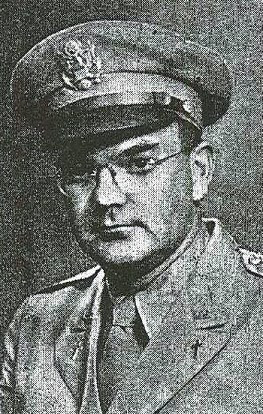 Photos courtesy of the Province Archives, Our Lady of Consolation Province, Conventual Franciscan Friars
His first intersection with historical events came on October 16, 1940, when he filled out his Selective Services card. He was called to action as Captain and Chaplain with the 8th Armored Division in Europe from 1945-1947.
He ministered to the soldiers and the wounded, witnessed the destruction and death from war, and the destitute civilians surviving in a ruined world. The 8th Armored Division website describes their journey from LeHavre to the Rhine in January 1945 where
gunfire from German planes wounded several men.
After his military service, he returned to Mt St Francis to teach, and in 1950 was tapped to help start a men’s Catholic college named Bellarmine. In his two decades at Bellarmine, he put his faith into action at the college and the broader community.
He stamped his legacy with social justice and promoted the intentions of Vatican II: ecumenism, equality and peace. The last decade of his life was woven around three passions: advocating for civil rights, developing Bellarmine to become a leading
co-educational Catholic university, and establishing the Merton Center.
He served as the first Registrar & Student Personnel Director and welcomed Black male students. In Kentucky, the 1904 Day Law prohibited Black and white students from being educated together, but a 1950 amendment allowed Black students to attend colleges
that offered courses not available at the all-black Kentucky State College for Negroes in Frankfort. Three Black men were among the 112 students who entered the first class at Bellarmine College. At the time, Louisville parks, public transportation,
theaters, restaurants, stores, pools, and water fountains were segregated. Starting Bellarmine as a college open to Black men was a signal that social justice would be part of his role as an educator.
Before equal opportunity became law, he recruited Dr. Henry S. Wilson, a Black man and Baptist, to teach chemistry in 1961, and who would become the university’s first full professor. In 1959, he recruited Dr. Margaret H. Mahoney, the first woman
professor at Bellarmine and by doing so required the college to build a faculty women’s bathroom.
Fr. John asked, “What good is having an ideal on a campus if there is no reflection of it in the general affairs of the community?” He and Monsignor Alfred Horrigan, President of Bellarmine were a team with a mission to be involved in the
larger community.
Civil Rights Advocate
In 1960, Louisville was still a segregated city and a proposed city ordinance to open public accommodations to all human beings regardless of skin color was defeated by Board Aldermen 11-1. Fr. John helped create traction for the civil rights movement
in Louisville by being involved with 50 sit-ins at downtown businesses and bringing Martin Luther King to town.
In 1964, the Allied Organization for Civil Rights’ officers Fr. John Loftus, Eric Tachau, Frank Stanley Jr. and Dr. Olof Anderson organized the March on Frankfort that attracted Martin Luther King, Jr, Jackie Robinson, Jr. and “the Queen of
Gospel” Mahalia Jackson. Fr. John led Bellarmine students and lobbied for a public accommodations bill in the 1964 General Assembly. He made Bellarmine classes optional that day and mobilized free transportation to Frankfort for students to
lobby for the public accommodations bill. He did not give up after it failed to pass in 1964 and carried on the cause to see it pass in the 1966 General Assembly. In 1965, Fr. John joined 50 other Louisvillians for the final two days of the march
from Selma to Montgomery.
He made time to reconnect with The 8th Armored Division on Wednesday, November 20, 1963, at the White House. About 10 veterans met with and presented President John F. Kennedy with a Citation for Peace from The 8th Armored Division. That Friday, November
22, Lee Harvey Oswald shot Kennedy in Dallas, Texas. The band of brothers had gathered to promote peace and their Commander in Chief was shot and killed two days later.
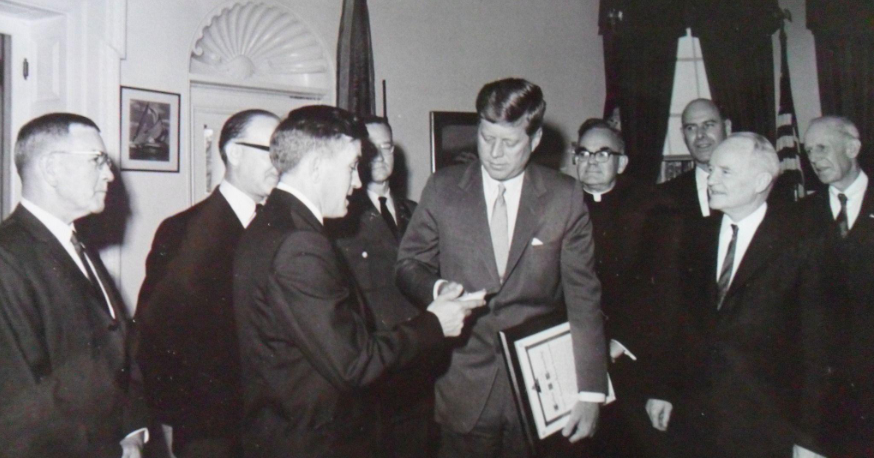 Photo courtesy of Maggie Palu 8th
Armored Division Association
Photo courtesy of Maggie Palu 8th
Armored Division Association
Merton Center Visionary
Woven throughout the 1960s is Fr. John’s friendship with Thomas Merton and the work to establish the Merton Center. They both brought social justice to their vocation as priests, but practiced differently - Merton’s through hermitage, contemplation,
and writing, and Fr. John’s through education, action, and advocacy. The Thomas Merton Studies Center started at Bellarmine in 1963 under Fr. John’s direction.
Fr. John reveals more of himself in letters to Merton. His August 24, 1964 letter discusses details about bringing Fr. Daniel Berrigan to Louisville and tells Merton “this has not been one of my happiest times”. Fr John was human –
he experienced grief, struggled with alcoholism, and assumed the burdens of leadership.
He reports on a scene from a National Catholic Educational Association meeting in Atlantic City, New Jersey. “Twenty thousand nuns scampering along the boardwalk afforded material for mediation. I should have kept a journal of reflections over the
years. Possibly I could have found a publisher even though I might fail an imprimatur.” Fr. John considers himself pushing the edges of what the Catholic Church would license to publish. Who better to share this revelation with than Thomas Merton?
In November 1964 the Merton Room officially opened at Bellarmine with a ceremony, and processes were in place to build the collection.
The monk and the priest made time for picnics. The Merton Center displays photographs from an April 6, 1967 picnic at Dom Frederic’s Lake at Gethsemane with Merton, Fr. John, Naomi Burton Stone (Merton’s literary agent), and others. Cheese,
bread, and Budweiser beer are laid out. Merton is in a white t-shirt and jeans looking robust while Fr. John looks grandfatherly with grey hair dressed in a cardigan sweater and black pants while wiping his glasses.
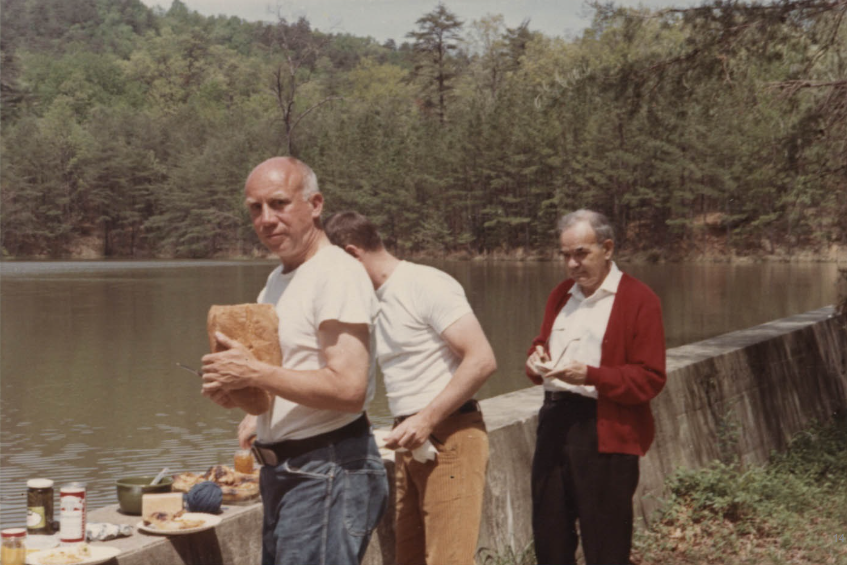 Photo courtesy of the Merton Center
Bellarmine Co-Education Pioneer
Two situations were swirling in his life in 1967 that would have aged him. First, he was leading a merger of Bellarmine and Ursuline Colleges to create a co-educational Catholic university.
Secondly, his health was in decline with severe degenerative cervical discs that caused brutal headaches, impaired use of his right hand, and extreme pain that made daily activity difficult. His August 31, 1967 memo to his superiors reports that his doctor
ordered him to enter St. Joseph Hospital on September 6 for aggressive therapy and neurological exams which would take a week to 10 days.
The therapies and any other treatment required recuperation time which meant he met me while convalescing at Marge & Jim Smith’s home which was four houses from mine. Gail, their youngest, was and still is my best friend. We were eight years
old, played in the den after school where Fr. John rested, read, or watched television. I imagine we played games, drew pictures, and read stories for our entertainment and his. Occasionally, I brought my younger sister Stephanie with me.
After returning to the friary house on Bellarmine’s campus and to work, he wrote a letter of thanks to me and Stephanie. It was the nicest letter I had ever received - typed on cream-colored stationery with an embossed seal of Bellarmine College.
Select Letters
Of course, I wrote back, and our correspondence continued almost monthly.
Milestones
In spring 1968, Fr. John was busy with the merger of Bellarmine College and Ursuline Women’s College that was officially announced in June 1968. He shared his contemplative side and his ever-present wit with me in a letter dated July 8, 1968.
Fr. John and Merton met for the last time on August 12, 1968, prior to Merton’s journey to Thailand. According to David Kocka’s John’s Story, it is alleged that Merton told John of the premonition of his death. Fr. John was supposed
to have replied, “That’s OK, Tom, if you go, I’ll be right behind you.”
September 1968 was a special occasion for Fr. John as 2,001 students were enrolled to attend the newly merged Bellarmine-Ursuline College, an independent organization with a self-perpetuating governing board. In his August 26, 1968 memo to friends
and students, he describes the new campus scene:
“A favorite projection is that some of the mutton-chopped lads and the miniskirted ladies (not bad adornment, either one) will be able to say honestly, ‘1968 was the year we made Bellarmine-Ursuline really come alive. Old what’s his
name was still around, and we took up his challenge to be interested in ideas…That was the year we had a new $100,000 playhouse and a million-dollar science building’…My contributions will be indirect. I trust they will not be
negligible.”
After the merger, Fr. John notes a milestone birthday on November 21, 1968 with a poem At Sixty. In free verse he reflects on a life of scars, growth, joys, struggles, names, questions, students, and wonders. He concludes, “Sixty comes too
suddenly! Will there still be ten?”
Less than two weeks after Fr. John’s birthday, Thomas Merton dies on December 11, 1968 in Thailand. Merton’s last correspondence to Fr. John is a postcard dated December 3, 1968 from Ceylon.
Final Correspondences
A few weeks later, I received a letter from him. As an adult, I realize he must have been grieving the loss of his friend. As a 9-year-old girl, I was excited about Christmas and must have asked him if he could send me a letter in French (since
I was taking French lessons).
Before Christmas, Stephanie and I received a delivery of Christmas corsages. His kind gesture made a lasting memory as the first flowers sent to me.
His last letter was dated December 30, 1968 telling me he had a wonderful holiday in Illinois with his brothers and sisters and thanking me for a picture of our family. As an adult, I notice the letter is typed by someone else versus the previous letters
appear to be typed by him. This one has his title and his initials and the initials of the assistant. Having an assistant would be part of his new role, but I wonder if the pain in his hand and arm was more severe preventing him from typing.
Passing
January 7, 1969 at 9:30 p.m. Fr. John died of a heart attack at the WLKY TV studio where he was taping Pastor’s Study, a panel discussion show. He did join Merton as supposedly predicted.
Fr. John’s life is honored with formal markings that include a bust sculpture at the Bellarmine W.L. Lyons Library, The Loftus House (retreat center) at Mount Saint Francis, and John’s Book: Writings of John Loftus edited by David Kocka.
Besides his accomplishments, Fr. John made time for what is precious in life - to notice beauty in nature and art, to have a sense of humor, to enjoy the cinema, to go on walks and picnics, to create poems and prayers, and to write 14 letters to a child.
Photo credits
1. Captain and Chaplain Fr John Loftus picture
Photos courtesy of the Province Archives, Our Lady of Consolation Province, Conventual Franciscan Friars
2. White House Peace Citation to President John F. Kennedy picture
Photo courtesy of Maggie Palu 8th Armored Division Association
3. Thomas Merton and Fr John picnic at Gethsemane picture
Photo courtesy of the Merton Center