Louisville is “super well-positioned” for the coming technology revolution, and Bellarmine’s
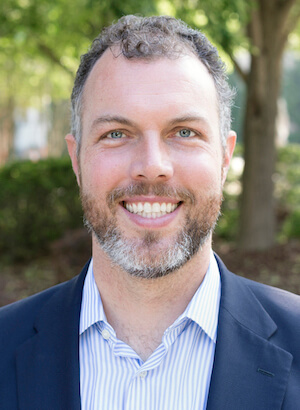
Rubel School of Business is perfectly aligned with its focus on entrepreneurship and analytics, says Ben Reno-Weber,
director of the new Future of Work Initiative, a Louisville-based regional hub for
artificial intelligence and data science created and backed by Microsoft.
“Everyone should understand what it means to start something. I want that to be part
of the culture of every school, and Bellarmine is farther along the curve than most,”
said Reno-Weber, who will discuss how AI and data influence creativity in the workplace
at Bellarmine on March 31.
Bellarmine’s MBA program is designed for innovation and targets those who are looking
for a broad-based MBA with an eye towards entrepreneurship, says Dr. Alisha Harper,
chair of Bellarmine’s Business Administration program. Many graduates have started
their own business ventures—some after earning the traditional MBA, others after pursuing
Bellarmine’s dual undergraduate/MBA track, which may be completed in five years.
The Rubel School and Story Louisville (900 E. Main St.), a co-working platform where
the Future of Work Initiative is based, collaborated on a series of free events this
spring to provide resources for startups and small businesses, and the Rubel School
will hold an Entrepreneurship Expo on campus in June.
Reno-Weber, who had worked for the World Bank and Boston Consulting Group, said he
became an “accidental entrepreneur” while serving as CEO of the nonprofit Kentucky
YMCA Youth Association. “I fell in love with a problem, which in my case was how to
do a better job of engaging people in volunteerism. You know how it is: You have crumpled
pieces of paper, you have to sign them, your kids are always losing them, guidance
counselors have to do something with them, or not.”
The solution he helped to develop was MobileServe, an app that makes it easy for organizations
to record their volunteer hours, and thus communicate their social impact, by automating
all of that. After five years with the startup, Reno-Weber felt the time was right
to move on. As he contemplated his next move, he was recruited by Microsoft to head
its Future of Work Initiative. “They were looking for someone who understood tech
and who could really manage the relationship parts of the data economy,” he said.
In describing that economy, he says the best analogy “is to imagine it’s 1994 and
everyone is going, ‘World Wide What?’ These data technologies that have come out,
but are still in the infancy of their adoption, are going to be enabling technologies.
They’re going to be like the internal combustion engine, or electricity, or the internet—they’re
going to touch everything.”
Microsoft is investing in midsize cities like Louisville in an effort to streamline
the process of previous technology revolutions, which “started with computer science
professors on the West Coast, then jumped to finance guys on the East Coast, then
slowly wandered to the middle of the country,” Reno-Weber said.
And this time, he says, Louisville has an unfair competitive advantage: an enormous
amount of data. “We have a Healthcare CEO Council from 12 of the largest healthcare
companies in the country who have agreed to share data to solve mutual problems. That’s
a totally unfair advantage. Pfizer just located the first of seven global health research
centers in Louisville. … We have the single largest database of opioid info here.
… All of those resources are ripe for entrepreneurs to hack on.”
But just as entrepreneurship is a mindset, so is data, he added. “The real interesting
thing right now about this new data economy is that it is as much cultural as it is
technical. The actual technology that most people will interact with in terms of artificial
intelligence is about the level of sophistication of Excel. I mean, you can do astrophysics
on Excel, but it’s not unapproachable. If you are digitally literate, you can use
this technology. The hard part is changing the mindset so that you recognize that
your data is valuable.”
As an example, he mentioned university admissions. “In a previous incarnation of the
universe, the students who say no to you are not useful information to you. But in
the data economy, you want to know everything you can about that person, so that you
can better target the people who are going to say yes.”
The Rubel School is building analytics literacy with its Analytics All Initiative,
which offers opportunities at both the graduate and undergraduate levels, Dr. Harper
said. For graduate students, there are two paths, an MBA with an Analytics Concentration
or a standalone Analytics Certificate. Beginning in Fall 2020, undergraduates in any
major can complete a Business Analytics minor. For undergraduates in Accounting, Finance
or Business Administration, the minor is a track that can be pursued by adding three
computer and data-science courses to the required business courses.